

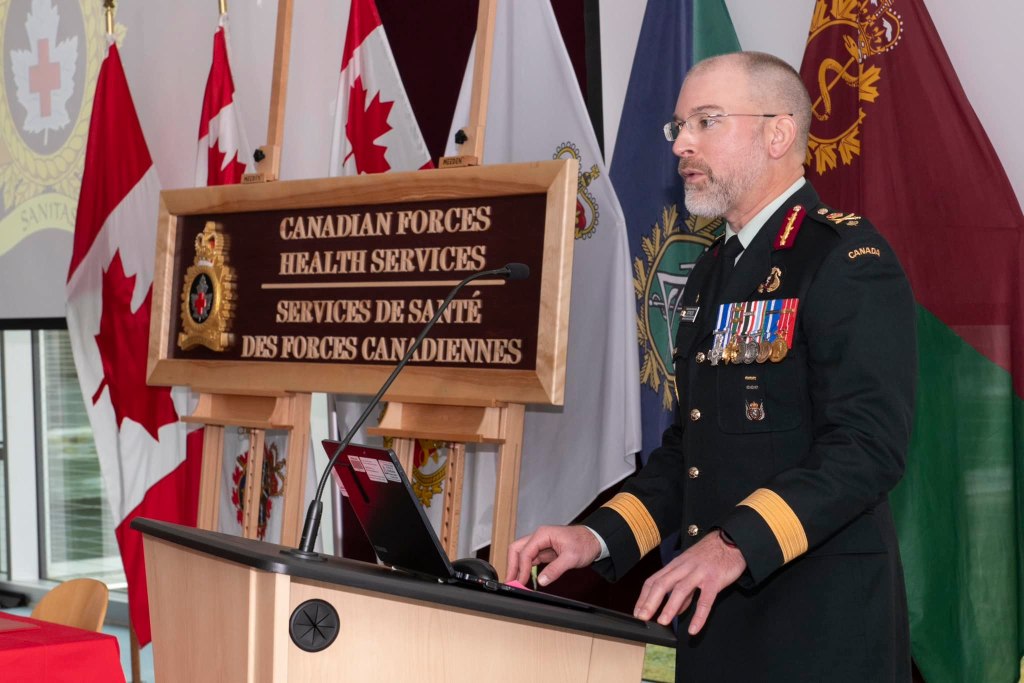
What does it take to lead military medicine across a country as vast as Canada? Decades of clinical expertise? The ability to make life-or-death decisions under pressure? Or maybe just the patience to navigate bureaucracy while keeping soldiers safe?
For Major General Scott Malcolm, serving as the Surgeon General of the Canadian Armed Forces is a profound honor, a mantle that carries both pride and immense responsibility. To represent Canada on the global stage as the nation’s senior medical authority is to stand at the intersection of leadership and service, where every decision can ripple across the lives of those who serve. Drawing on twenty-six years of experience, from deployments overseas to clinics at home, Malcolm works tirelessly to ensure that every member of the CAF receives healthcare that is safe, effective, and compassionate. In his eyes, the role is more than policy or oversight. It is a commitment to the people whose courage and dedication sustain the military.
“I believe in perseverance. If you set your mind on a task and are willing to work hard, you can achieve it.”
Major-General S.F. Malcolm
The start of Malcolm’s journey to this pinnacle was forged in moments both ordinary and extraordinary, but each left an indelible mark on the path that he would follow. In his adolescence, Malcolm was drawn to the images and stories of war that flickered across screens and spilled from the pages of books. A poor test mark in grade seven became a lesson in perseverance; in grade nine, a pharmacist’s encouragement to study medicine set him on a new course. University offered its own unique turning points, from the physical challenge of being a varsity athlete to a chance encounter with a surgeon who guided him toward the medical military officer training plan. Step by step, a trajectory for Malcolm’s future would be shaped, one that would ultimately lead him to the role he occupies today.
Speaking of education, Malcolm’s academic journey reads like a map of ambition. It stretches from Nova Scotia to Harvard, then across the country and back again, each stop adding a new layer to his expertise. Motivated by competition more than fairy tales, he recalls reading about a fellow Nova Scotian admitted to Harvard and deciding that he could achieve the same. At Harvard, Malcolm found himself immersed in a world of diversity and intensity, challenged as much as inspired, and ended up with a bachelor’s degree in biochemistry. From there, he returned to Canada to earn his Doctor of Medicine from Dalhousie University in 2001, followed by a Family Medicine residency at the University of British Columbia. Years later, he added yet another credential: a Master of Public Administration from the Royal Military College of Canada.
After all those years, Malcolm still points to his second year at Harvard, where he balanced all-nighters, varsity athletics, and a part-time job to fund his education, as the most difficult period of his life. Yet that year exposed him to new perspectives and cultivated resilience that would serve him both in medical school and later, into the unpredictableness of military leadership. It was an environment that demanded adaptation, endurance, and humility, which are qualities that echo throughout Malcolm’s career today.

Malcolm’s commitment to youth engagement is therefore deeply personal and strongly rooted in his own experiences growing up in a small community with few resources or mentors. Hailing from Cape Breton Island, Nova Scotia, specifically the tiny community of Lower River Inhabitants of just 17 houses, he understands how transformative guidance and exposure to opportunity can be and works to provide that to the next generation. Malcolm’s hope for the next generation of leaders is also grounded in their openness, less ‘pessimistic’ attitude, and global perspective. He hopes that today’s youth maintain “that broad view” throughout their leadership journey, “because that perspective tends to narrow with age and experience, but youth today are thinking bigger, and that gives me hope.” For Malcolm, programs like SHAD offer a space where motivated youth across the country (and beyond) can explore STEAM, leadership, and social innovation while being challenged to think creatively and push beyond conventional boundaries. “Youth engagement energizes me,” he says. “Everything remains possible. Youth aren’t constrained in their thinking, and that inspires new ideas and fresh perspectives that I can learn from as well.”
SHAD, by the way, is a Canadian national summer program that brings together high-achieving students to explore STEAM, leadership, and social innovation through workshops, projects, and mentorship. I actually met Malcolm initially at SHAD 2025 at Carleton University in Ottawa, where, as a fellow alumnus, I saw how passionately he champions the organization. Reflecting on our own conversation weeks ago, he adds that “I get energized, I get new ideas from unconstrained, innovative, inspiring leaders like yourselves. And then I also help to create ideas around… …what potential exists or what challenges I’m facing and ideas that you may have to share that can help me out.”
When it comes to advice for youth interested in the military or medicine, Malcolm heavily emphasizes the importance of preparation, discipline, and mindset. Physical fitness, he notes, is vital, not just for health but for developing resilience and self-discipline. Leadership should be cultivated early, even in small ways, like volunteering or taking initiative in community projects. “Start considering service to your country, to your society, even to your family,” he says. “Developing habits of putting others before yourself will carry you far.” On the medical side, he stresses cultivating strong study habits and the ability to learn ‘how to learn’, as the challenges of higher education and medical training can oftentimes be overwhelming without foundation. Most importantly, he reminds aspiring doctors and/or military personnel to ask themselves why they are pursuing these paths. “It really needs to be something more than prestige or status,” he says. “Your heart needs to be around improving the healthcare of your patients, serving others, and making sacrifices for the greater good.”
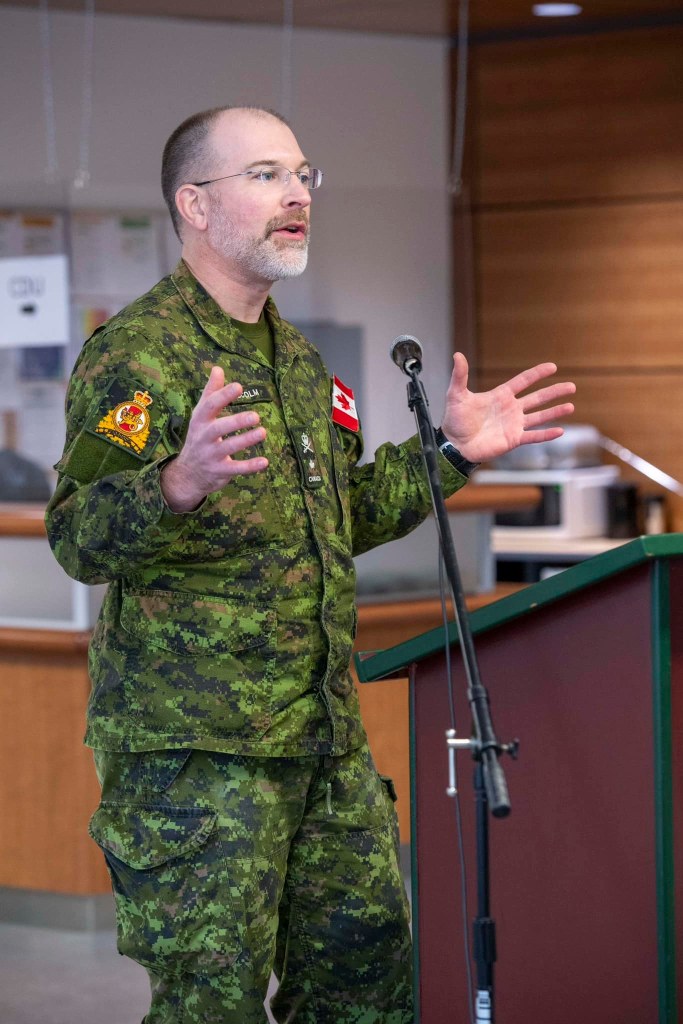
Despite the title and visibility of his position, Malcolm observes that most Canadians have little understanding of what the Surgeon General actually does. Many confuse his role with the U.S. Surgeon General or assume that the military relies entirely on the civilian healthcare system. “A lot of people think it’s my name on [the] cigarette packages,” he laughs, “which, of course, it isn’t. That’s the U.S. Surgeon General, a civilian position.”
In reality, the Canadian Armed Forces (CAF) operate its own healthcare network, distinct from provincial and territorial systems, as CAF members are excluded from the Canada Health Act. This system must meet the needs of deployable personnel in high-risk environments, while maintaining confidentiality and high standards of care. “I think Canadians take healthcare a bit for granted,” he reflects, noting that understanding the nuances of military medicine requires recognition of both its independence and its complexity. For Malcolm, part of his role is to bridge that knowledge gap, explaining the specialized nature of military healthcare wherever he can: sometimes with a wry smile, sometimes with a gentle nudge at common misconceptions. Military medicine, he explains, is medicine at its core, but practiced in a world that demands adaptability and ingenuity.
Each day for MGen Scott Malcolm is a study in contrast, moving seamlessly between the granular and the global. While the structure of his workday might appear dominated by meetings and emails, the substance is anything but mundane. One moment, he is addressing the personal concerns of a service member facing medical release, navigating questions about treatments not yet funded. The next, he is orchestrating complex logistics for frontline care in conflict zones, from transporting blood across the world to ensuring medical teams can operate safely under fire. He cites Ukraine as an example, where helicopters cannot safely evacuate patients as they did in Afghanistan, requiring creative solutions to deliver care without compromising the safety of medical personnel. Simultaneously, he collaborates with civilian healthcare systems to build resilience and prepare for scenarios in which large numbers of casualties arrive at once.
“Medicine is about making sure, regardless of who the patient is, that they are treated to the best of our abilities.”
At the heart of Malcolm’s work, however, lies the delicate balance between compassion and duty. As a medical officer in the military, he must navigate the tension between caring for individual patients and maintaining the operational readiness of the forces he serves. Confidentiality and trust remain paramount to his concerns, but the demands of the military chain of command require careful communication and foresight. There is also a moral complexity unique to military medicine –which is the commitment to heal and protect extends even to those who may be considered ‘adversaries’.
Amid the unpredictability of such responsibilities, Malcolm has cultivated routines to remain grounded. Physical fitness has long been a cornerstone of his life and career, but it became particularly intentional during the pandemic. He and his wife, a healthcare professional, began nightly walks to decompress and debrief, each striving to reach ten thousand steps while sharing the day’s triumphs and challenges. A busy family life with four children and their various sports activities also adds another layer of balance, which helps ensure that work never consumes all his hours. Sleep, he notes, is non-negotiable.
While all CAF medical personnel are trained in the civilian healthcare system, their work in the military adds layers of responsibility and context that are entirely unique. Beyond caring for patients, they must consider the operational readiness and deployability of those they serve. Specialty care often occurs within civilian hospitals, but deployed operations. From Afghanistan to humanitarian missions in Sri Lanka, Haiti, and Pakistan, these situations often require providers to deliver advanced care in austere and unpredictable environments. The military’s innovations, he notes, are often born of necessity. Prosthetics refined through war, the use of drones to transport medical supplies, advances in blood products, and the widespread adoption of tourniquets to save lives in the field are all examples. These lessons, born on the front lines, increasingly inform civilian practice, highlighting the ways military medicine pushes the boundaries of what is possible in healthcare.
The humanitarian impact of CAF medical teams is both vast and deeply personal. Malcolm recalls the 2004 tsunami in Sri Lanka, when the Disaster Assistance Response Team treated nearly 8,000 patients over forty days, delivering lifesaving care amid the chaos. More recently, during the COVID-19 pandemic, CAF health services were deployed to repatriation flights from Wuhan, China, and Japan, long-term care facilities in Ontario and Quebec, and the national vaccine rollout. These missions illustrate not only the breadth of military medicine but also its capacity to touch lives far beyond the battlefield, protecting some of Canada’s most vulnerable citizens while demonstrating the humanity at the heart of service.
Yet the weight of command in a combat zone is unlike anything most leaders will ever face. Malcolm’s first deployment to Afghanistan placed him in charge of a medical unit tasked with supporting soldiers in battle a role that meant sending trained medics forward alongside infantry troops as they moved into attacks.
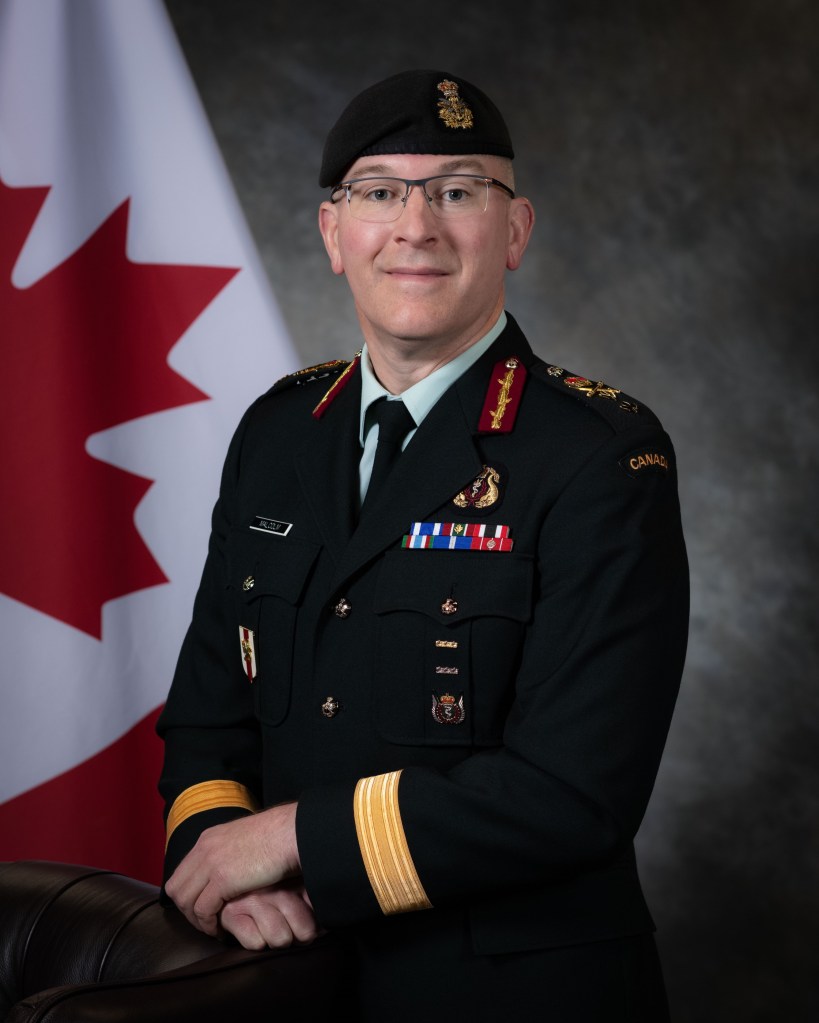
One of the most difficult moments during this deployment came when a member of his team initially refused to go forward. With every possible reason carefully ruled out, the decision was his alone. “I had to tell them, ‘On this date, at this time, you will leave this camp and do your job,’” he recalls. “And the reason that was so difficult is that I was clearly ordering that individual into harm’s way, and I had no idea if, in the next day, the next week, or the next month, they might be injured or killed.”
Another test came in the waning days of the tour, when fatigue had etched itself into every face and the thought of home hung just beyond reach. In those moments, soldiers became acutely aware of their own fragility. Malcolm had to turn to his youngest medics – some barely eighteen or nineteen, just a few years older than I am – men and women he had trained, eaten with, and lived beside for more than a year. He asked them to shoulder one last mission.
They went.
They returned.
In the end, everyone on Malcolm’s team would make it home. But the weight of that final order, and the knowledge of what could have been, would never truly leave him. “Leadership is easy if you’re leading robots,” he says. “But we’re dealing with human beings, and each has their own unique needs and wants. The person you’re leading is someone’s son, daughter, wife, cousin, spouse.” It is a truth that sits heavy, even years later, a stark reminder that leadership is not measured only by plans executed or objectives achieved, but by the care taken with the lives entrusted to you. That burden, he admits, can be daunting. But it also fuels his determination to ensure the systems, training, and support are in place so that when the moment comes, the Canadian Armed Forces can protect its members as fiercely as they protect the nation.
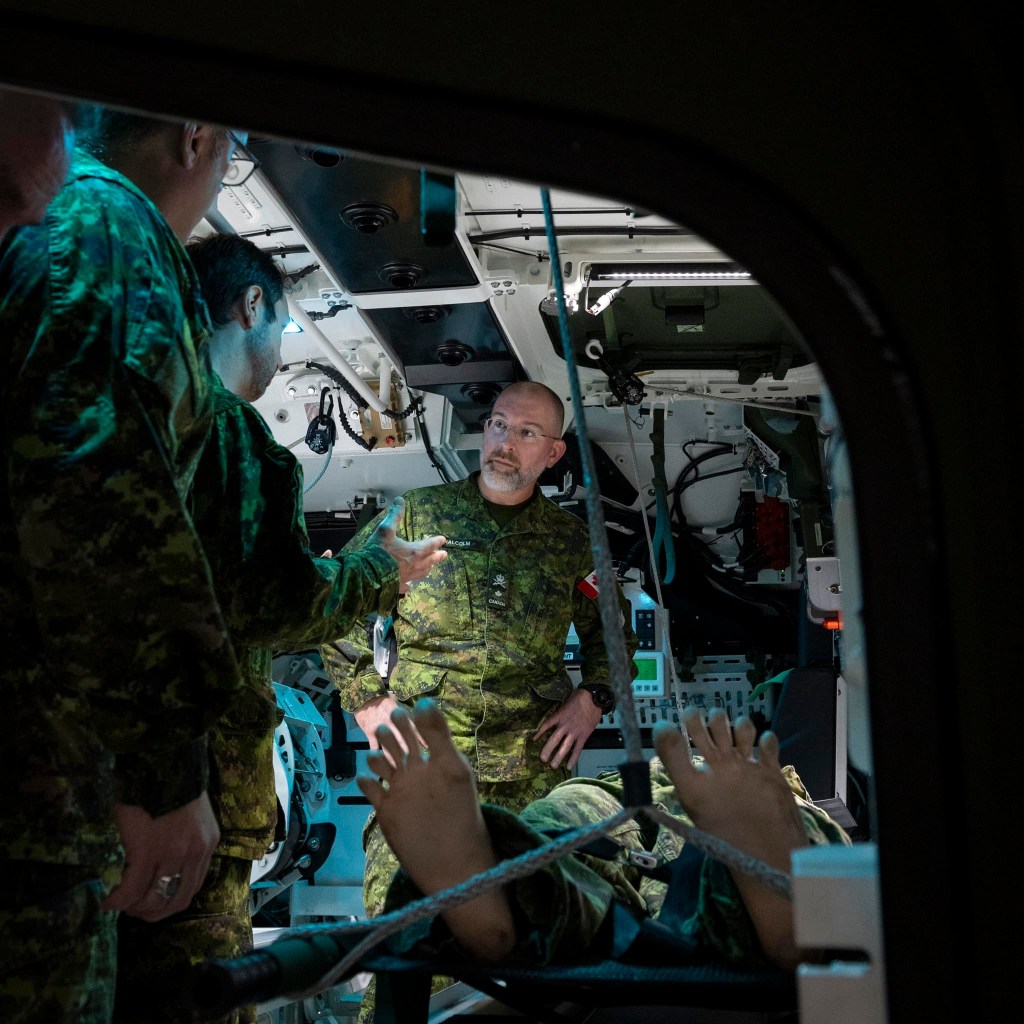
Tn the realm of medical innovation, Malcolm focuses on life itself and the technologies that preserve it under impossible conditions. He speaks with particular excitement about advances in damage control resuscitation, strategies designed to keep bleeding patients alive long enough to reach definitive care. Traditional substitutes like saline cannot replace the vitality of blood, yet transporting blood in battle or at sea presents monumental logistical challenges. Canada’s legacy with plasma is being renewed with experiments in freeze-dried plasma, which can endure heat and time without refrigeration, buying precious minutes in the field. Similarly, damage control surgery allows teams to stabilize patients with targeted, initial interventions, providing critical time for evacuation to safer facilities. Malcolm even imagines drones or autonomous systems extending these capabilities to remote northern communities, both in Canada and worldwide, demonstrating that battlefield ingenuity can ripple back to benefit civilian healthcare in extraordinary ways. Beyond immediate care, he is invested in building national resilience, exploring domestic vaccine production as a lesson learned from pandemic vulnerabilities, showing that innovation in the military often carries broad societal value.
International collaboration is also essential for keeping CAF healthcare effective and responsive. Partnerships like NATO allow for shared planning, interoperability, and mutual support in times of crisis. “We discuss how to ensure proper patient evacuation, how to address medical logistical challenges, and how to bolster each other’s efforts,” Malcolm explains, noting that lessons learned from Russian aggression in Ukraine or deployments in Afghanistan are shared across borders. In a globalized battlefield or humanitarian effort, no nation operates in isolation. The collective strength of allied medical services amplifies Canada’s own capabilities and ensures that when crisis strikes, expertise and care can flow seamlessly across nations.
Underlying all of Malcolm’s guidance are two core personal values: keeping one’s word and acting with integrity. “If I give you my word, I will do it. Your word is one of the few things you truly own, and it defines your credibility,” he explains. On integrity, he recalls a friend’s definition: doing what is right even when no one is looking. For Malcolm, this principle is essential both as a military officer and as a physician. These values shape his understanding of service – not as a title or position, but as a commitment to others, to one’s team, and to the broader community.
“[This job] is exciting and dynamic. I have to be able to zoom in at times, but then zoom out at others, so it really keeps me on my toes.”
As our conversation comes to an end, MGen Malcolm begins to reflect on his career, and considers the legacy that he hopes to leave. He recalls a conversation with his wife about a year ago, when she asked whether it had all been worth it – the sacrifices, the long hours away from family, the challenges, and the struggles.For Malcolm, the answer became clear during the COVID-19 pandemic. In his role as the Canadian Armed Forces representative at the federal government table for pandemic planning, he coordinated repatriation missions to bring Canadians home from China and Japan, planned deployments into long-term care facilities, and played a critical part in the national vaccine rollout. “The accumulation of my career experiences put me in a position to execute on that and potentially save tens of thousands of Canadians’ lives,” he reflects. For him, that period marked the pivotal moment of his career. Had it ended then, without ever becoming Surgeon General, he could have walked away knowing he had made a tangible impact on his country and its people. “Serving as Surgeon General is the cherry on top,” he tells me, “but my focus is always on leaving the organization and the society [in better condition].”’
Indeed, whether on a battlefield, at home, or in a classroom, MGen Scott Malcolm’s story has come full circle. The boy who once devoured images and stories of war now shapes the stories of service, resilience, and possibility for the next generation. And if you listen closely, even in the quiet of his Ottawa office, there are still echoes of the places and moments that shaped him: the media that drew a younger him into the military, the lessons learned in conflict zones, the challenges of coordinating care during a pandemic, the inspiration of youth engagement, and the reminders of the people he serves. Those echoes guide every decision, plan, and conversation, as Major General Scott Malcolm, the Surgeon General of the Canadian Armed Forces, continues his mission: to leave every team, every community, and every life he touches better than he found them.
 Youth Journalism Alliance
Leave a comment