

News
Starting Small, Hitting It Big: Young Scientists Engineering the Future
We’re all living in the same world—but do we all see it the same way? How often do we stop going through the motions and really see the world? How often do we take a step back and notice what’s around us?
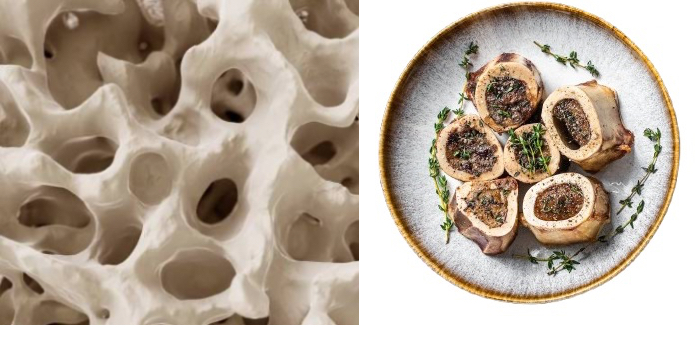
How often are we truly curious, noticing the porous structure inside the bones in the delicious dish?
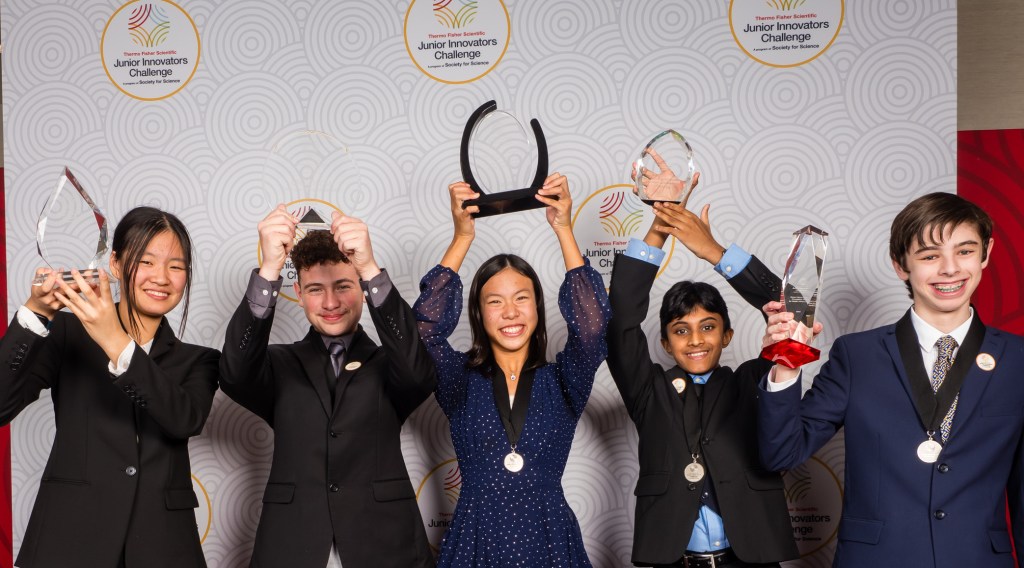
When we look at everyday objects, most of us see background props. But some young scientists see a solution instead. Transforming their ideas into science research projects, many of those young innovators present their findings at science fairs, where academic and industry experts gather to evaluate their work. Just two months ago, 30 middle schoolers from across the country were selected to participate in the Finals Week of the Thermo Fisher Scientific Junior Innovators Challenge, the top science fair nationwide for middle school. Thermo Fisher JIC, formerly Broadcom MASTERS, invites top 10% of regional science fair participants to compete each year. Out of over 2000 competitors, only 30 finalist advance to the finals week, an event as thrilling as the Super Bowl for middle school science enthusiasts. Tina Jin, 13, and Samvith Mahadevan, 14, two of those top 30 finalists, eventually took home the $25,000 Thermo Fisher Scientific ASCEND (Aspiring Scientists Cultivating Exciting New Discoveries) Award, the top prize of the competition, and the $10,000 Lemelson Foundation Award for Invention respectively. Both of them reflected on how their long journey to becoming the top winners inspired them to continue pursuing research.
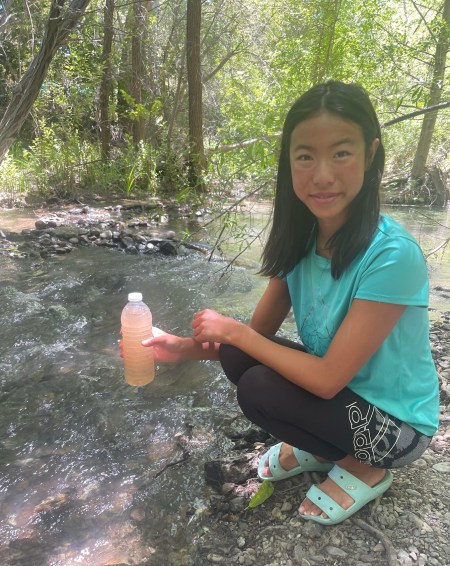
Tina Jin, taking water sample for testing from a local creek. Photo Credit: Society for Science
Jin and Mahadevan both focused on small, everyday aspects of their lives in order to make headway on solving pressing real world problems. Jin’s project centered around using animal bones to filter water, creating an accessible method that produced potable water while significantly reducing costs. One day, while sitting at her dining table, she noticed something peculiar about the cow bones, “At dinner, I saw that the pore structure of cow bones…was actually a similar structure to polymer membranes, which are a useful material for water filtration.” Based on her observation, she launched a science project to develop an accessible water filter for everyone, especially for those living in extreme poverty. After designing and beginning her experiment, Jin then reached out to various water companies to have her water tested. “The San Jose Water Company replied, and they were happy to help me with the final testing of my research,” Jin recounts. The testing revealed that her all-natural filter, made from bovine bone marrow, could reduce E-coli bacteria by 90% and purify water by 99%. Encouraged by these results, Jin is confident her research will be able to help many people and make a meaningful impact on the world. But all big trees have to start from small seeds, Jin’s passion for science took root at a very young age — her early experiments included ‘making my own one-ingredient slime recipes!’ What began as a fascination with science toys soon blossomed into a deep drive for scientific research.
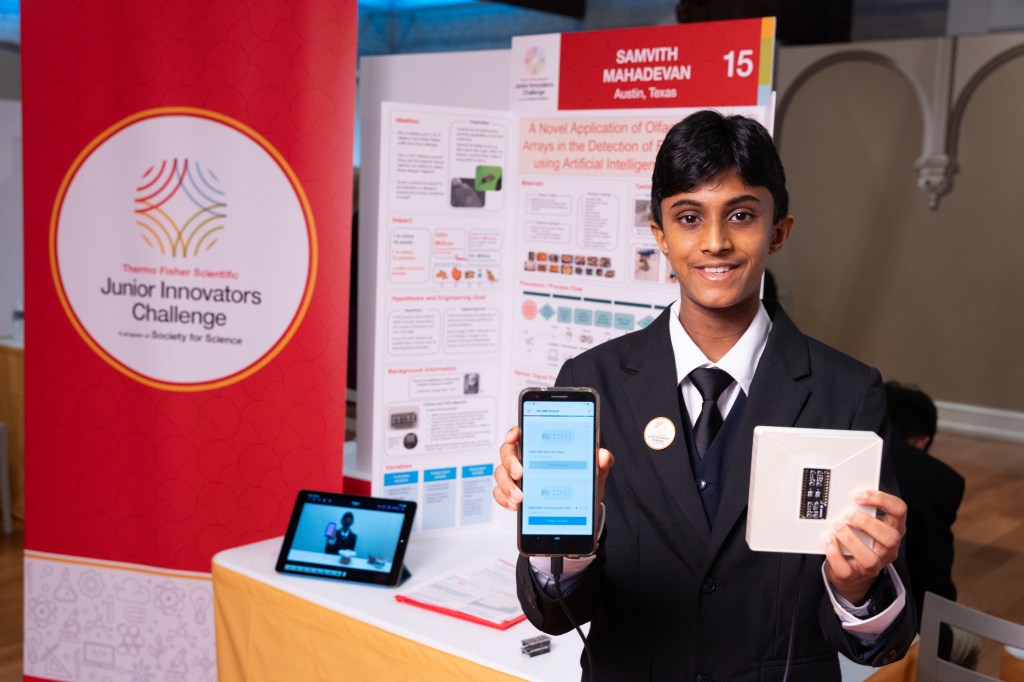
Samvith Mahadevan at the finals’ week for Thermo Fisher Junior Innovators Challenge. Photo Credit: Society for Science
In an amazingly similar manner, Mahadevan’s project started from something small—the ants in his kitchen. “I saw the ants and how they were able to detect sugar through their sense of smell, which is pheromones, so I wanted to try to mimic that,” Mahadevan recalls what triggered his initial idea.

Illustrated by Rory Hu
Drawing on his own experience with severe allergies, Mahadevan decided to apply the ants’ olfactory prowess to sniffing out food allergens instead. He used a volatile organic compound sensor and trained an AI algorithm to detect products such as eggs, almonds, or peanuts. At the conclusion of his research project, his invention can classify and identify multiple allergens with an accuracy greater than 90%. Like Jin, his inspiration from a mundane aspect of his life quickly became the root for tackling a real world issue: “I wanted to solve the problem for me and the millions of other people who have similar conditions.”
Jin, Mahadevan, and other young scientists across the country are using their curiosity and passion to change the world. They hope to inspire other kids to join them in their research endeavors. For middle schoolers trying to start a project, Mahadevan offers this advice: “If you feel stuck…it’s always important to look around you and within you and notice those small things, small details that most people might overlook, because they can give inspiration for a lot of great ideas.”
Start small. Ask questions. With keen eyes and a scientific mindset, you might one day see what Jin and Mahadevan saw in cow bones and ants—a gateway to an entirely new world: the world of scientific research.
 Youth Journalism Alliance
Leave a comment